
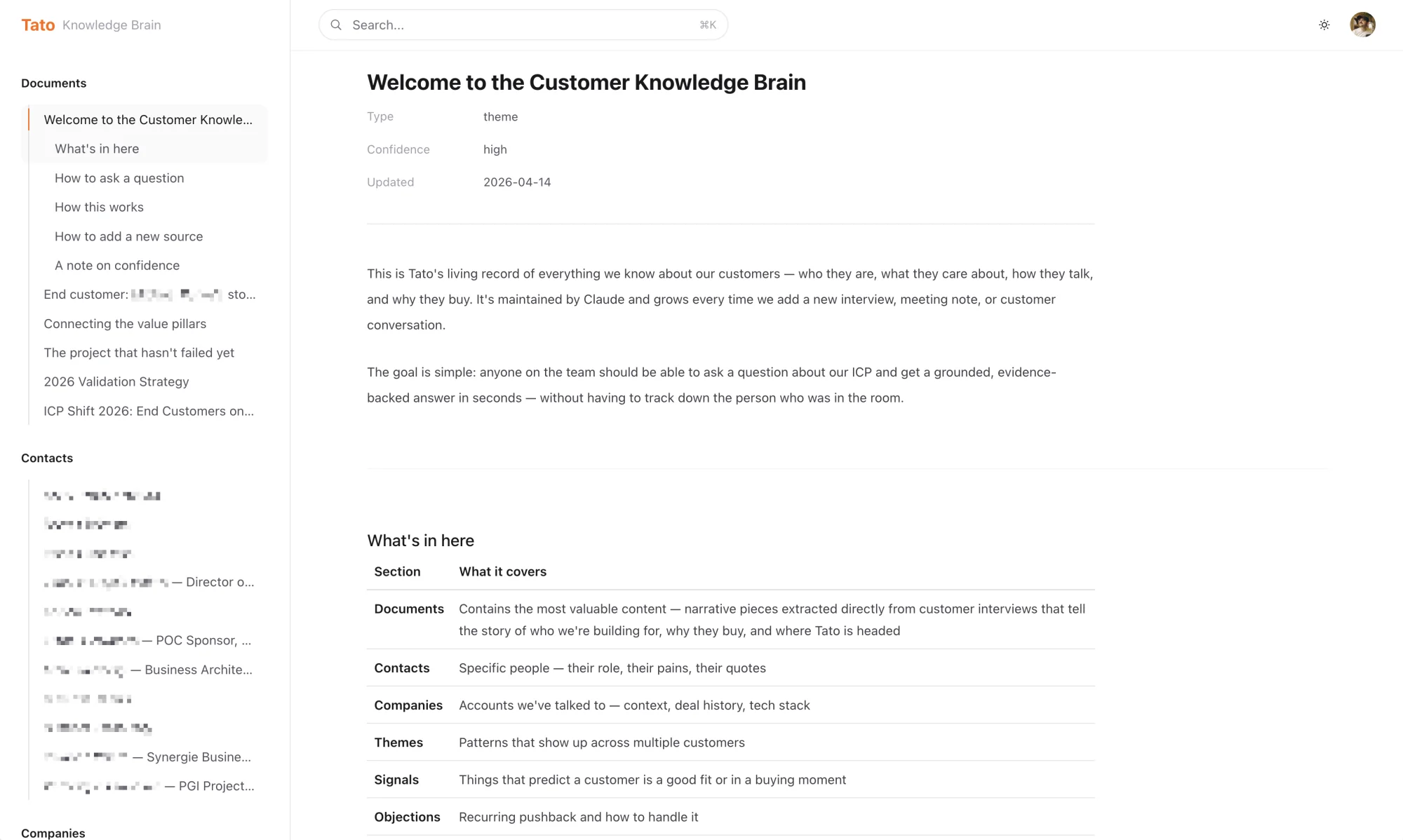

This started as a personal experiment: build a second brain, with AI doing the reading, writing, and remembering, and find out whether treating it as an actual thinking partner, not just a lookup tool, made my thinking clearer and my output faster.
Customer knowledge was the obvious first target. Interview transcripts, sales calls, CRM exports, industry reports, and ERP documentation all held signal, but almost none of it was reachable when I was writing a PRD or debating positioning. It lived in people's heads and a pile of files nobody could search by meaning.
- 01
Customer knowledge was tribal: locked in the heads of whoever had been on the call.
- 02
Every PRD, positioning debate, and pitch restarted from memory instead of evidence.
- 03
Raw transcripts and reports were unsearchable by meaning, so past conversations were effectively write-only.
Approach
The design follows Karpathy's LLM wiki pattern:
a repository of structured markdown pages with YAML frontmatter that Claude
reads, reasons over, and maintains. Humans drop raw sources in; Claude owns
the wiki.
Sources are immutable. Transcripts, meeting notes, LinkedIn profiles, CRM
exports, and industry documentation land in a raw/ directory and are
never edited. An ingest command has Claude read the source and distill
it into typed wiki pages: contacts, companies, cross-customer themes,
buying signals, objections, vocabulary, and industry context. Each page
carries a confidence rating (explicit quote, inference, or hypothesis),
namespaced tags, and [[wiki links]], so the whole thing forms a
traversable knowledge graph. Because the raw layer is preserved, the wiki
can always be re-derived, and git history is the audit trail.
Search runs through qmd, a local hybrid
BM25/vector engine for markdown. It vectorizes every page on-device with no
API keys, and exposes itself as an MCP server: when Claude gets a
question, it retrieves by meaning first, then follows links for context
instead of grepping filenames.
One source of truth, behind SSO
A knowledge base only compounds if the whole company reads from it. We shipped a small Next.js app that renders the wiki and put it behind Clerk SSO: anyone signs in with their @tato.co Google account and browses every page. The same repository serves three audiences: the web app for the team, Obsidian for graph exploration, and Claude for retrieval.
Ingest at scale, then think
The core loop is mass ingestion followed by conversation. I batch-feed customer calls and meeting exports, let Claude distill them into pages, then push back on what it found: where does this contradict what Michael told us in April, which of these quotes came from a pitch-heavy call we shouldn't over-trust. Every customer-facing transcript gets scored against the Mom Test on ingest, so compliments and hypotheticals from a pitch don't masquerade as evidence.
That back-and-forth is where the leverage shows up. The strongest insight in the wiki, that systems integrators resist Tato because it removes their commercial leverage, which makes SI resistance a buying signal rather than an objection, came out of a thinking session across multiple ingested calls, not from any single one.
PRDs with the Linear MCP
The wiki became the substrate for the rest of my product workflow. When I
scope a project, Claude queries the knowledge base for the pains, quotes,
and vocabulary relevant to it, then drafts the PRD as a set of issues and
documents directly in Linear through the
Linear MCP: problem statement, personas,
and acceptance criteria, each grounded in a citation back to the wiki page
it came from instead of my recollection of a call. I read and edit from
there, but the first draft already argues from evidence.
One quarter I used this to restructure the whole backlog into build-order milestones: Claude worked through the wiki theme by theme and produced a full set of PRDs directly as Linear issues, sequenced so each one unblocked the next instead of landing as a flat, unordered list. Anyone reviewing a PRD could click straight through to the transcript or quote it was built on, so disagreements became "let's look at the source" instead of "I remember it differently."
Diagramming and ideation with the Figma MCP
The same loop applies to diagramming. I bring rough notes, or just describe
a flow out loud, and Claude pulls in the wiki's context (the personas, edge
cases, and vocabulary that apply) and produces a first-pass diagram
directly on a Figma page through the
Figma MCP: frames,
flows, entity relationships, whatever the conversation calls for. From
there I refine by hand or keep iterating conversationally, telling Claude
what's wrong with the layout instead of redrawing it myself.
The real value showed up at the ideation stage. Sketching a diagram used to be expensive enough that I'd only do it once I was fairly sure of the idea. With Claude producing a rough version in the time it takes to describe it, the cost of visualizing a half-formed idea dropped close to zero, so more of them got explored instead of staying as notes. The starting point is never a blank canvas anymore.
Outcome
Two customers ingested became twenty-plus accounts and 140 wiki pages, with sixty logged operations (ingests, queries, PRDs, lints) in the activity log. Customer knowledge that used to evaporate after each call now compounds: every new transcript makes the next answer better, and industry pages feed directly into Tato's own agent initiative as curated per-vertical knowledge.
The quieter shift is in how product work starts. PRDs, positioning discussions, and pitch prep now begin with a query instead of a memory, something like "what does our ICP actually say about vendor disputes", and the answer comes back with citations.
The experiment held up: treating AI as a genuine collaborator, on top of a second brain it could actually read, sharpened my thinking and raised my output. I spend less time reconstructing context I already gathered once, and more time on the decision itself.
Next case study
Meeting taxonomy