

Before we could fix anything, we had to name what wasn't working.
- 01
We didn't know who our users were.
- 02
The team didn't understand the ERP space.
- 03
We didn't have a shared vision of what we were building.
Approach
Q2 became a reset. We shifted our ICP from the Systems Integrator who sets up the ERP to the end customer who actually uses it, which meant closing a real understanding gap. ERPs are foreign territory for most people, and the team needed a shared sense of who we serve.
I started by aligning with sales, then ran hour-long sessions with end customers. The sessions stayed open: no script, just understanding their world and their pains.
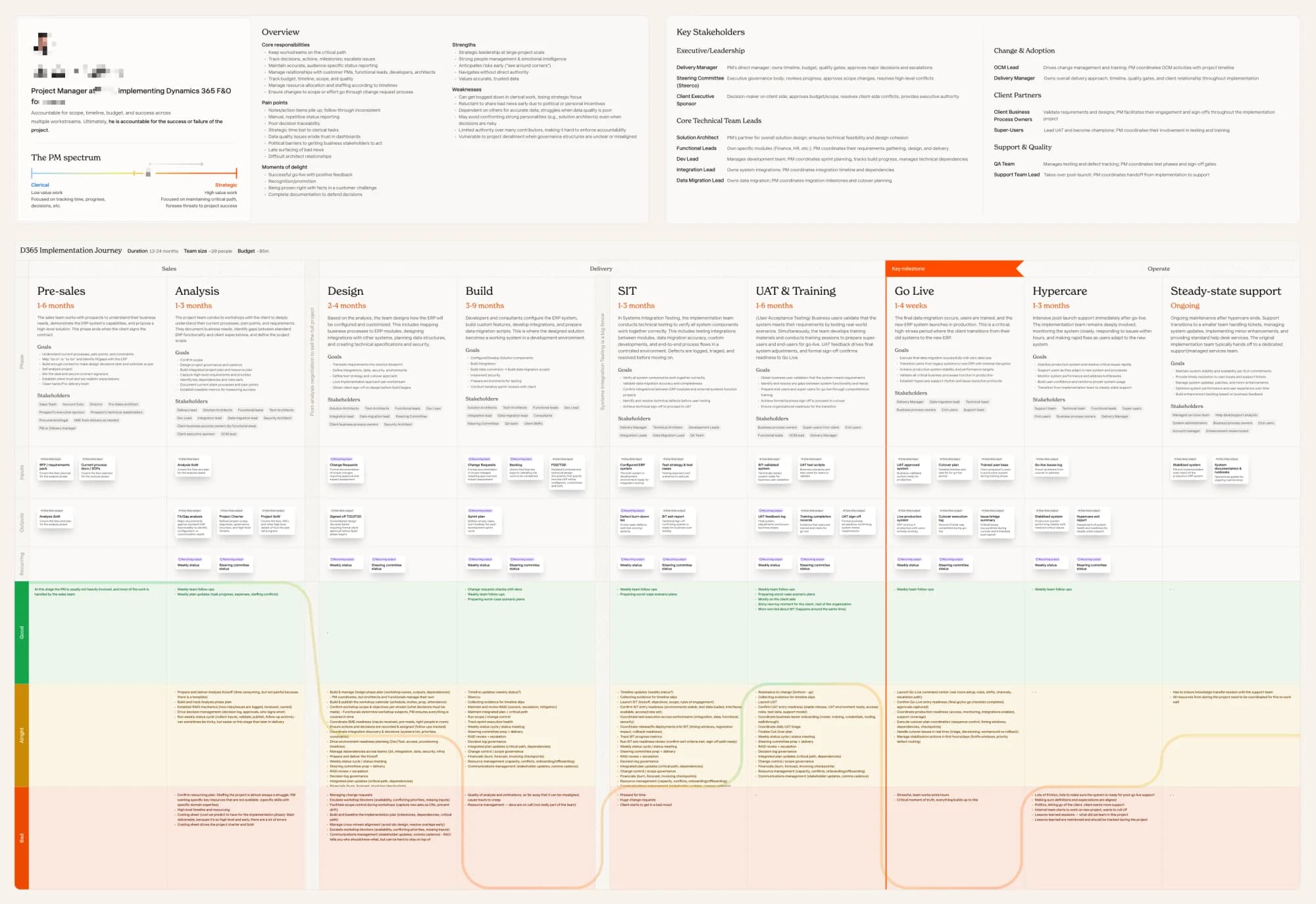
The journey map
From those conversations I built a User Journey map, which became the foundation for the rest of our product work. Instead of scattered notes on what different customers said, it laid out their process step by step: what they're doing, where they get stuck, and what they need from an ERP integration at each point. That gave sales, design, and engineering one artifact to point to instead of separately held assumptions.
Job stories
I broke the journey down into Job Stories, then grouped those into themes and workflows. Job stories describe a situation and a motivation rather than a persona and a feature request, which kept us focused on what customers were trying to get done instead of designing around who we assumed they were.
The knowledge base
Alongside it, I built an internal knowledge base, loosely modeled on
Karpathy's LLM wiki pattern:
a living wiki the team keeps current instead of re-reading raw notes every
time a question comes up. It's vectorized with
qmd so it's efficient for LLMs to parse, and
it's become the place we check instead of re-explaining ERP concepts from
scratch. We use it to answer questions, write PRDs, and help with
diagramming in Figma.
Key learnings
- 01
Project Managers live on a spectrum from clerical to strategic. The highest value work is strategic, but they get bogged down in clerical work.
- 02
End customers are good at their jobs, but often inexperienced in ERPs. They have knowledge gaps they don't know about, and those gaps are what cause friction with their consultants.
- 03
Implementations are long and complex, and most failures trace back to early miscommunication and requirements missed at the start.
Outcome
The journey map and knowledge base gave the team a shared vision instead of scattered assumptions, and became the foundation for how we built product for the rest of the year, not just that quarter. A few of the projects it shaped:
Automation routines
Turning skills and reports from something you run into something that arrives on its own.
RAID 2.0
Cutting meeting extraction noise in half and putting a human in the loop.
Next case study
Automation routines