

Tato extracted six entity types from every meeting: Changes, Risks, Assumptions, Action Items, Issues, and Decisions. On paper that's thorough. In practice it produced a wall of overlapping items that most users scrolled past.
- 01
The six types overlapped: a change was usually a decision, an issue was a risk that had already happened.
- 02
Extraction produced more items per meeting than anyone could act on.
- 03
Items were read-only snippets. If Tato got one slightly wrong, you were stuck with it.
Approach
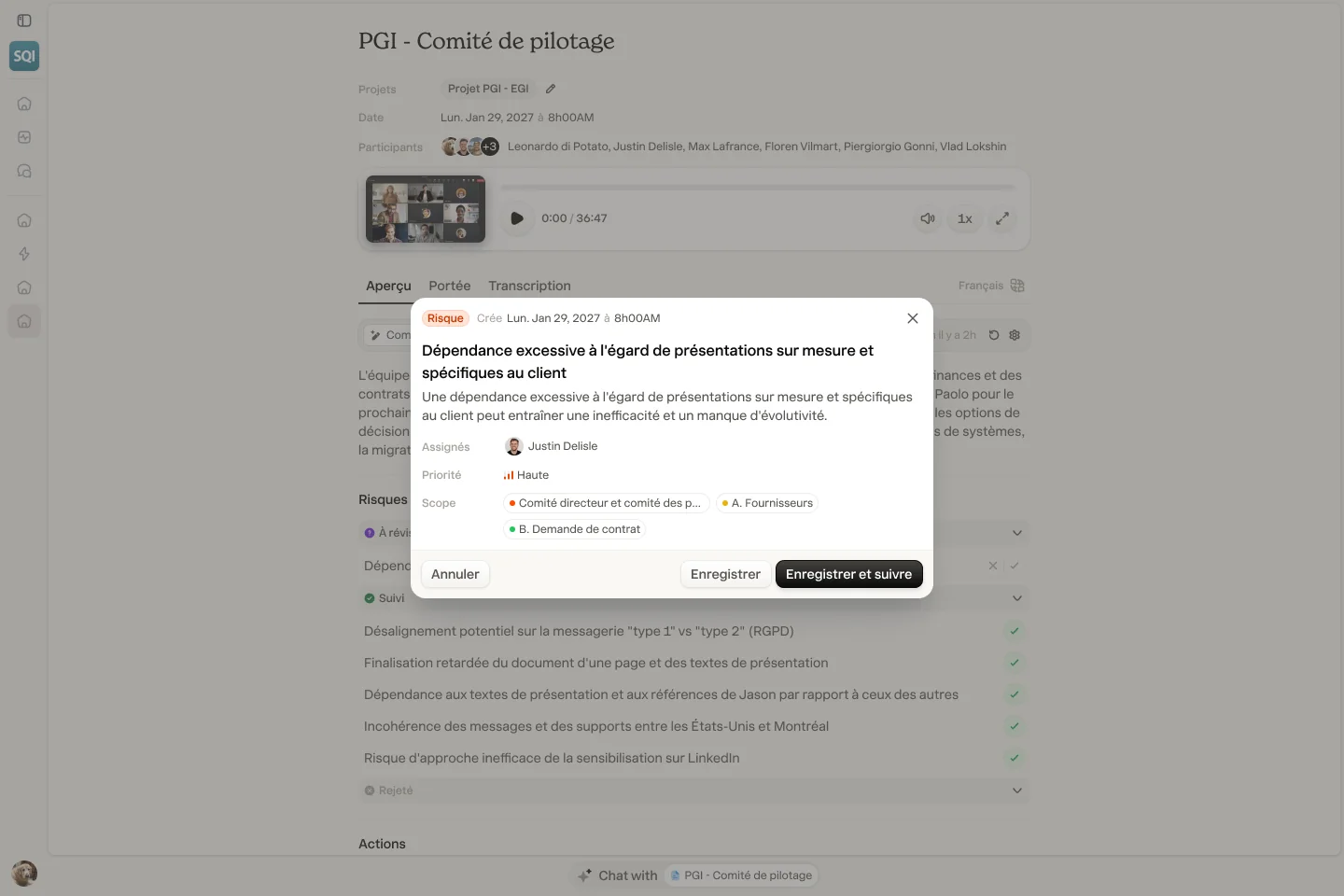
We replaced the six types with three: Risk, Action Item, Decision. A risk has an owner and a priority: critical, high, medium, or low. An action item has an assignee and a due date. A decision is attributable to a person and tied to the meeting where it was made. Everything else was cut. The target was blunt: roughly half the items per meeting, so the list after a meeting is short enough to act on in a minute.
A human in the loop
Cleaner extraction only matters if people trust it, so every item became reviewable. After a meeting, items land in a needs-review list on the summary. From there the user edits what Tato got slightly wrong, dismisses false positives, and tracks what matters. Tracked items move to the RAID page and get monitored across meetings, with badges showing what's new and what changed since last time. Tato does the reading; the user makes the calls.
Editing isn't limited to a form, either. Drop in a file or tell Tato what changed in chat, and it updates the item and timestamps the edit. Risks, actions, and decisions link to each other too, so a decision traces back to the risk that prompted it.
The rollout
Replacing entity types means touching customers' existing data, so the rollout became its own project. We ran it in three phases over a month: a banner prompted people to review and track what mattered, the new view became default two weeks later with a manual switch-back, then the cutover went permanent. Tracked items migrated with full history. Everything else, including the retired Changes, Assumptions, and Issues types, was archived instead of deleted, and CS could still pull an item back on request.
Outcome
RAID went from a wall of snippets people scrolled past to a short list they clear after each meeting. Risks persist until someone resolves them, and decisions carry a paper trail back to the meeting and speaker where they were made. The project is also the core of Proactive Visibility, an objective I own: giving customers independent visibility into implementation risk before sign-off, not after.
Next case study
Customer knowledge base